Managed Kubernetes (K8s)

kubernetes beget kubernetes beget

Managed Kubernetes by Beget allows you to quickly deploy a Kubernetes cluster in the cloud without complex infrastructure setup.

The platform is suitable for business, development, and application scaling: from startups to high-load systems.

kubernetes beget
Connects in just a couple of minutes
Flexible configuration to suit your needs
Transparent pricing

Calculate the service cost

🇷🇺 Russia, Saint-Petersburg
Cost per
Day
Month

Configuration

Basic — 1 master node
For development, training, and test environments. If the node is rebooted, the cluster will become unavailable.
0,01 € day
Fault-tolerant — 3 master nodes
For production environments with fault tolerance. If one node fails, the cluster will continue operating.
1,23 € day

Node group parameters

Number of nodes:
Group #1
Flexible configuration with Intel Xeon Scalable and AMD EPYC 3–3.3 GHz processors for most tasks. If you’re not sure which configuration is right for you, start with the minimum one — you can upgrade the configuration at any time.
2 cores / CPU
2
6
9
12
16
4 GB / Memory
4
11
18
25
32
30 GB / NVMe
30
85
145
200
255
0,39 € day

Managed Service for Kubernetes — service for managing clusters in the Beget cloud

Managed Kubernetes is a Kubernetes as a Service (KaaS) model in which the provider takes over management of the system’s key components.

The service includes:
Fully managed Control Plane
Fast launch and setup
Integration with networking and storage
Automatic updates
manage kubernetes beget

Benefits of Managed Kubernetes by Beget
beget kubernetes advantages
convenience kubernetes beget

Simple and convenient Kubernetes management

An intuitive interface and automation simplify cluster creation and configuration, even for complex projects.

Quick start with Beget Kubernetes

Fast cluster deployment

Cluster launch takes just a few minutes. You can quickly get started right away.

performance kubernetes beget

High infrastructure performance

High-performance hardware and resources ensure stable application operation.

reliability kubernetes beget

Reliability and fault tolerance

The infrastructure is properly distributed and reliably protected against failures.

flexibility kubernetes beget

Support for microservice architecture

Ideal for developing modern applications.

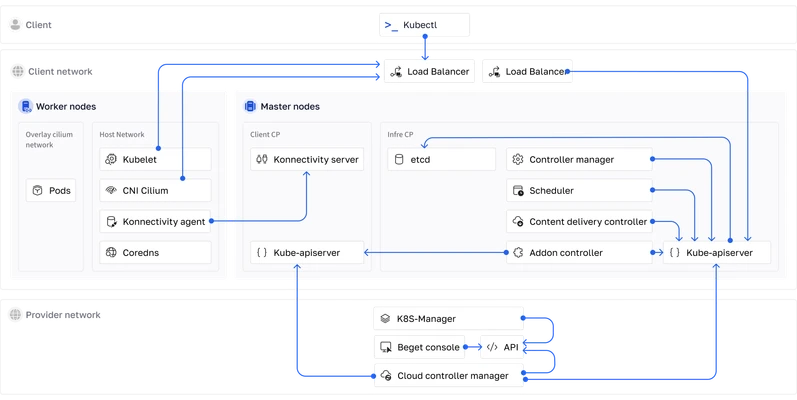
Managed Kubernetes workflow
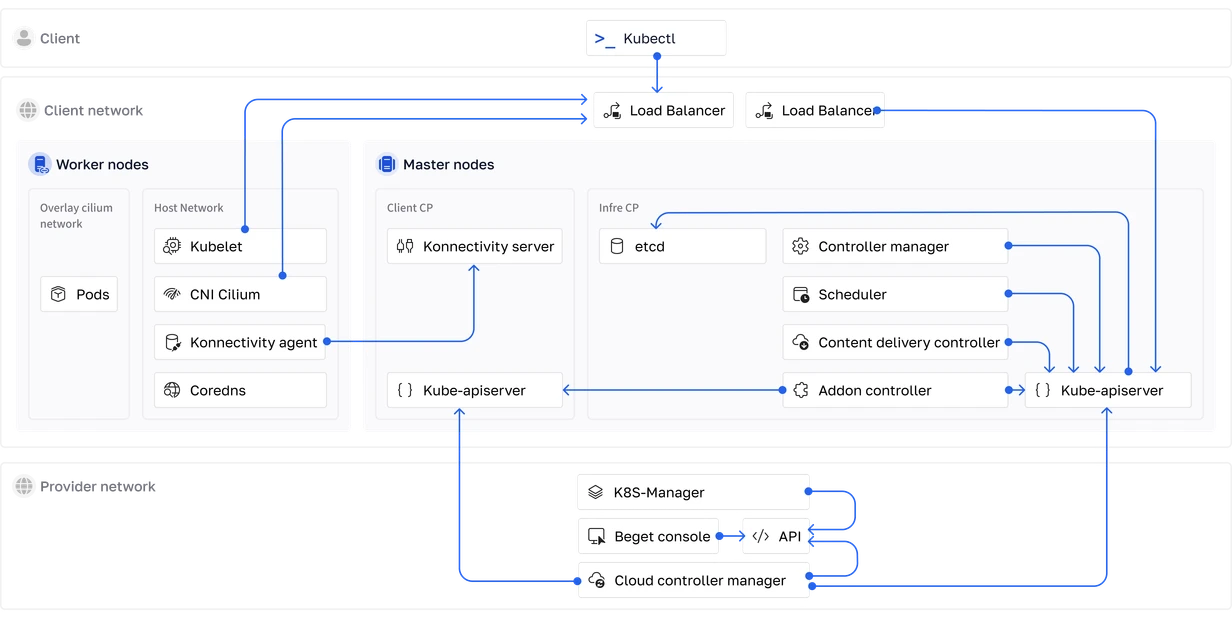
Beget Kubernetes architecture Beget Kubernetes architecture
To view the entire diagram, move the image left and right.

What tasks Managed Kubernetes solves
containerization kubernetes Beget

Application containerization

Simplifies the use of Kubernetes for launching and managing containers.

optimization kubernetes Beget

IT infrastructure optimization

Reduces costs and improves system fault tolerance.
DevOps simplification with Beget Kubernetes

Simplifying DevOps processes

Accelerates development and the release of new product versions.

Responsibility zones in Managed Kubernetes

Beget

Control Plane:
Management and updates
Infrastructure:
Availability and reliability
Worker nodes:
Environment support
Security:
Basic protection
Data:
Storage

Client

Worker nodes:
Scaling
Applications:
Deployment and support
Security:
Access configuration
Data:
Backup
Beget Client
Control Plane
Management and updates
Infrastructure
Availability and reliability
Worker nodes
Environment support
Scaling
Applications
Deployment and support
Security
Basic protection
Access configuration
Data
Storage
Backup

Which projects use Kubernetes as a Service?

SaaS and cloud services

Ensures stable operation and infrastructure scalability

SaaS projects in Beget Kubernetes

E-commerce platforms

Helps handle peak user loads

E-commerce platforms in Beget Kubernetes

Financial and analytics systems

Гарантирует высокую доступность и безопасность данных

FinTech projects in Beget Kubernetes

Development and testing

Simplifies the creation of temporary containerization environments

Development in Beget Kubernetes

Our clients

Beget ClientBeget ClientBeget ClientBeget ClientBeget ClientBeget ClientBeget ClientBeget ClientBeget ClientBeget ClientBeget ClientBeget ClientBeget ClientBeget ClientBeget ClientBeget ClientBeget ClientBeget ClientBeget ClientBeget ClientBeget ClientBeget ClientBeget ClientBeget ClientBeget ClientBeget ClientBeget ClientBeget ClientBeget ClientBeget ClientBeget ClientBeget ClientBeget ClientBeget ClientBeget ClientBeget ClientBeget ClientBeget ClientBeget ClientBeget ClientBeget ClientBeget ClientBeget ClientBeget ClientBeget ClientBeget ClientBeget ClientBeget ClientBeget ClientBeget ClientBeget ClientBeget ClientBeget ClientBeget ClientBeget ClientBeget ClientBeget ClientBeget ClientBeget ClientBeget ClientBeget ClientBeget ClientBeget ClientBeget ClientBeget ClientBeget ClientBeget ClientBeget ClientBeget ClientBeget ClientBeget ClientBeget ClientBeget ClientBeget ClientBeget ClientBeget ClientBeget ClientBeget ClientBeget ClientBeget ClientBeget ClientBeget ClientBeget ClientBeget ClientBeget ClientBeget ClientBeget ClientBeget ClientBeget ClientBeget ClientBeget ClientBeget ClientBeget ClientBeget ClientBeget ClientBeget ClientBeget ClientBeget ClientBeget ClientBeget ClientBeget ClientBeget ClientBeget ClientBeget ClientBeget ClientBeget ClientBeget ClientBeget ClientBeget ClientBeget ClientBeget ClientBeget ClientBeget ClientBeget ClientBeget ClientBeget ClientBeget ClientBeget ClientBeget ClientBeget ClientBeget ClientBeget ClientBeget ClientBeget ClientBeget ClientBeget ClientBeget ClientBeget ClientBeget ClientBeget ClientBeget ClientBeget ClientBeget ClientBeget ClientBeget ClientBeget ClientBeget ClientBeget ClientBeget ClientBeget ClientBeget ClientBeget ClientBeget ClientBeget Client
Kubernetes FAQ

Frequently Asked Questions

Didn't find what you were looking for? Try: